
Incoterms Explained
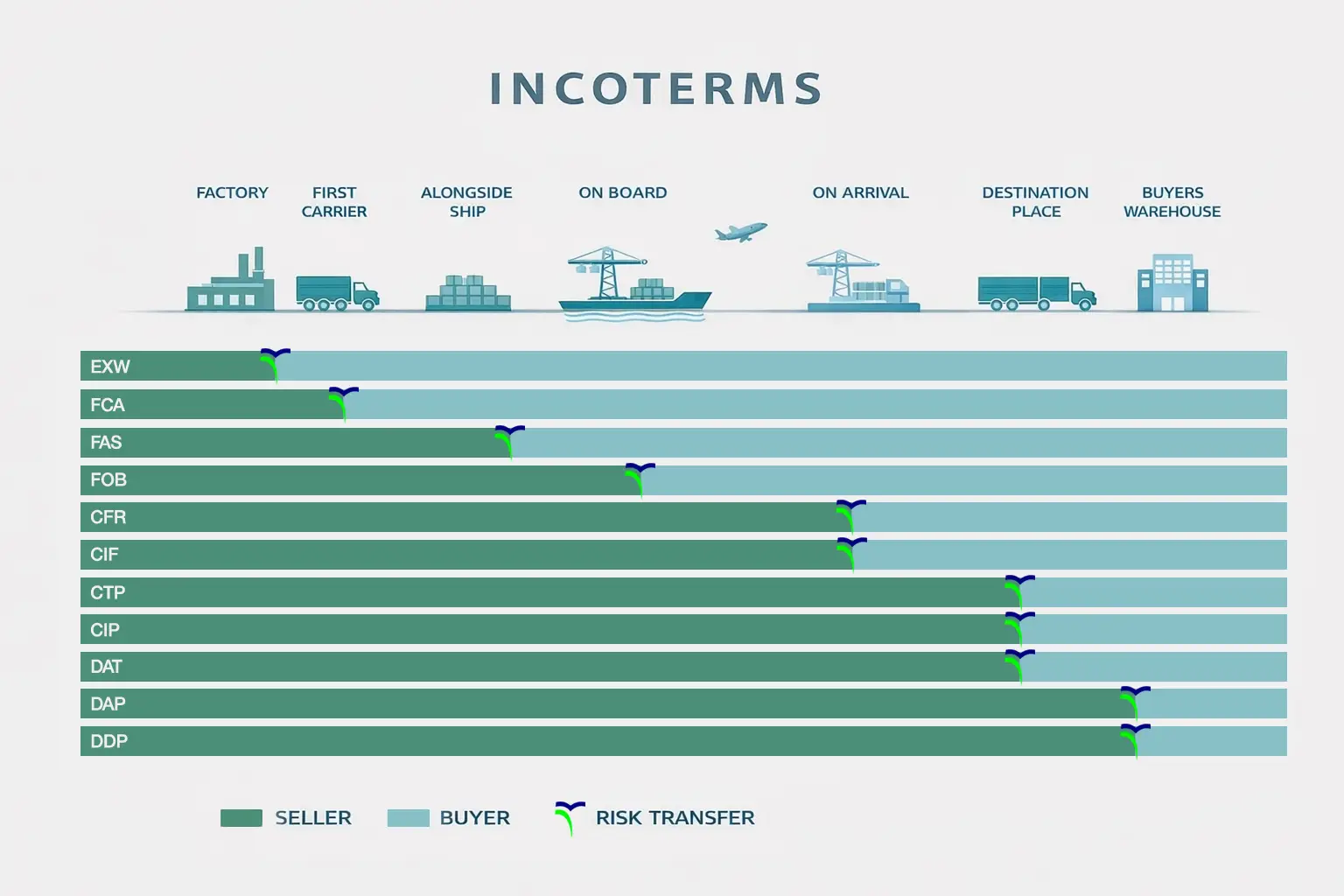
Understanding Responsibility & Risk
Incoterms define who is responsible for costs, tasks, and risk at each stage of a shipment. This chart helps you quickly see where responsibility shifts between seller and buyer, and where risk typically transfers.
What Does This Mean for My Shipment?
Simple explanations for the most common terms.
EXW
Ex Works
Seller makes goods available at their place. Buyer handles almost everything.
Seller
Makes goods available at seller’s premises.
Buyer
Pickup, export clearance (often), main freight, import, final delivery.
Risk transfers: At seller’s premises (very early).
Can cause export clearance issues if the buyer cannot handle local procedures.
FCA
Free Carrier
Seller delivers to the buyer’s carrier at an agreed location. Cleaner than EXW.
Seller
Delivers to carrier / agreed place. Typically handles export clearance.
Buyer
Main freight, import, final delivery.
Risk transfers: When handed to the carrier at the agreed place.
FAS
Free Alongside Ship
Seller delivers goods alongside the vessel at the port. Buyer takes over from there.
Seller
Delivers goods alongside the vessel at the named port.
Buyer
Loading on vessel, ocean freight, insurance, import, final delivery.
Risk transfers: When goods are placed alongside the vessel.
FOB
Free On Board
Seller delivers on board the vessel. Buyer takes over after loading.
Seller
Handles origin costs until goods are on board the vessel.
Buyer
Ocean freight, insurance (if desired), import, final delivery.
Risk transfers: Once goods are on board the vessel.
Sea/inland waterway only (not for air freight).
CFR
Cost and Freight
Seller pays ocean freight to destination port. Buyer handles import and delivery.
Seller
Pays ocean freight to destination port.
Buyer
Insurance (if desired), import, duties/taxes, final delivery.
Risk transfers: Once goods are on board the vessel (even though seller pays freight).
CIF
Cost, Insurance and Freight
Seller pays ocean freight + minimum insurance to destination port.
Seller
Pays ocean freight + minimum insurance to destination port.
Buyer
Import, duties/taxes, final delivery.
Risk transfers: Once goods are on board the vessel.
Insurance coverage may be limited (minimum).
CPT
Carriage Paid To
Seller pays main carriage to destination. Buyer handles import and delivery.
Seller
Pays main carriage to the named place (any mode).
Buyer
Insurance (if desired), import, duties/taxes, final delivery.
Risk transfers: When handed to the first carrier (often earlier than people expect).
CIP
Carriage and Insurance Paid To
Seller pays carriage + insurance to destination (any mode).
Seller
Pays main carriage + insurance to the named place (any mode).
Buyer
Import, duties/taxes, final delivery.
Risk transfers: When handed to the first carrier.
Insurance terms can vary—confirm coverage level in your agreement.
DAT
Delivered At Terminal
Seller delivers goods unloaded at a named terminal in destination country.
Seller
Arranges carriage and delivers goods unloaded at terminal.
Buyer
Import clearance, duties/taxes, final delivery.
Risk transfers: When goods are unloaded at the terminal.
In Incoterms 2020, DAT was replaced by DPU (Delivered at Place Unloaded).
DAP
Delivered At Place
Seller delivers to destination address or point. Buyer handles import duties and taxes.
Seller
Arranges delivery to the named place (ready for unloading).
Buyer
Import clearance, duties/taxes, unloading (typically).
Risk transfers: At destination when goods are ready for unloading.
DDP
Delivered Duty Paid
Seller handles delivery including import duties and taxes. Highest seller responsibility.
Seller
Delivers to destination including import clearance and duties/taxes.
Buyer
Usually only unloading and receiving the goods.
Risk transfers: At destination when goods are ready for unloading (seller carries most obligations).
Use carefully—creates tax and compliance exposure for the seller.
Key Differences (Fast Comparison)
A quick way to compare terms by risk transfer and typical use.
Ready to ship?
Send your cargo details and destination — we’ll recommend the best route, service option, and required documentation, then guide the next steps.